Eflatunpınar—a Hittite sacred spring on the shores of Lake Beysehir
Imagine: a clear spring gushes from the ground, cold even in the Anatolian heat, and around it, three thousand years ago, Hittite craftsmen built a monumental trachyte basin, decorated with gods and mountain spirits in hierarchical order. Eflatunpınar (Turkish: Eflatunpınar) is one of the few surviving Hittite religious monuments in an open landscape: no roofs overhead, no fences around. Just stone, water, and sky. Eflatunpınar is located in the Beysehir Lake National Park, 85 km west of Konya, in the historical region of Pisidia. The site has been on UNESCO’s tentative list since 2014 as the “Hittite Sacred Water Temple.” This is the southwesternmost point of Hittite expansion in Asia Minor—the frontier where this great civilization left one of its last marks on stone.
History and Origins of Yeflatunpınar
The Hittite civilization reached its peak in the 14th–13th centuries BCE, spanning most of the Anatolian Plateau. It was during this period—the Late Bronze Age—that the Eflatunpınar monument was erected on the shores of Lake Beysehir. The Turkish scientific community dates it to the 14th century BCE, that is, to the time of the immediate predecessors or contemporaries of the Hittite King Tudhaliya IV (reigned ca. 1237–1209 BCE).
The site was not chosen by chance: two natural springs with clear, cold water flow from the ground here. For the Hittites, water was sacred—it symbolized a connection to the underworld of the gods and gave life. The monumental reservoir, lined with hewn blocks of trachyte (a volcanic rock), served both as a practical structure and a religious space: the cult of the sacred spring (“arimatta” in Hittite texts) held an important place in the Hittite pantheon.
Researchers have identified Yeflatunpinar with the “spring of the Arimatta basin” mentioned in the treaty between the Hittite king Tudhaliya IV and King Kurunta of Tarhuntassa. This treaty has come down to us on a bronze tablet found during excavations at Hattusa (modern-day Boğazköy)—the Hittite capital. The exact correspondence between the place name and the monument remains a subject of debate, but this version is considered the most convincing.
In the Middle Ages, during the Seljuk period, the monument acquired a new interpretation: it began to be associated with Aflatun—the Arabized name of the Greek philosopher Plato. Hence the name “Eflatunpınar”—“Plato’s Spring” or “Violet Spring” (the second meaning of the word “eflatun” in Turkish is “lilac”). The monument, created a thousand years before Plato, unexpectedly took his name simply because Konya (Iconium) was associated with Greek philosophy during the Seljuk era.
The site was mentioned by Oxford University researcher Lucia Nixon and is based on the works of F.W. Haslak from the early 20th century. No full-scale systematic excavations have been conducted here to date. Its location on the lake shore corresponds exactly in latitude to another important monument on the opposite shore—the ruins of the Kubadabad Saray, built by the Seljuks in the 13th century.
Architecture and What to See
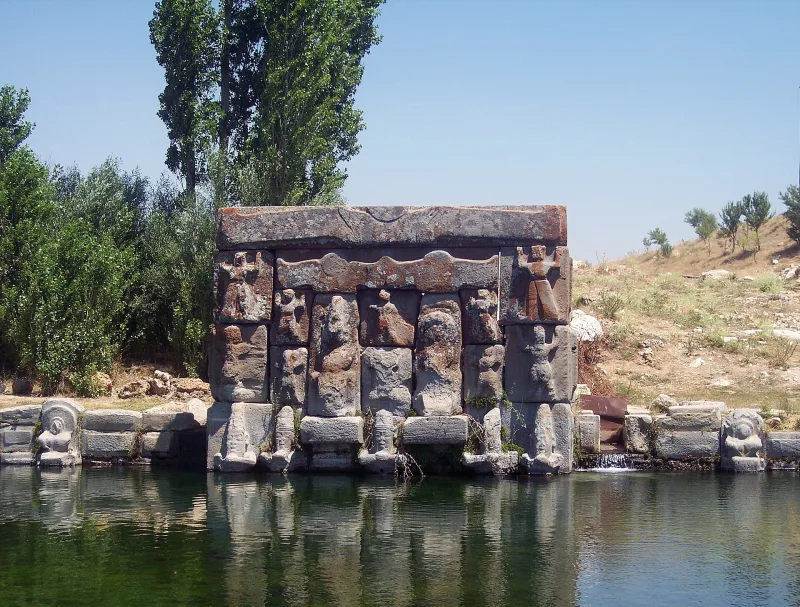
The main monument at Eflatunpınar is a stone reservoir pool approximately 7 meters wide and 4 meters high, constructed from 14 trachyte blocks. Trachyte is a volcanic rock quarried in the region: durable, yet relatively easy to work with. The masonry is monumental, with the blocks carefully fitted together.
Relief images on the main monument
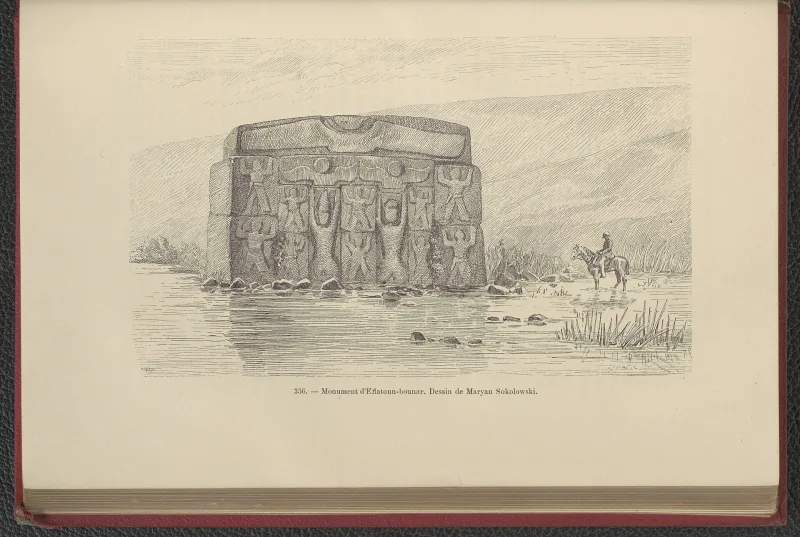
A hierarchical depiction of the Hittite pantheon is carved on the facade of the main monument. In the lower row are five mountain gods wearing characteristic scaly skirts: this is how the Hittites depicted mountain spirits. Above them sits a “divine couple”: male and female figures who, according to researchers, represent Tarhunna, the god of thunder, and Arinnitu, the sun goddess—the supreme deities of the Hittite pantheon. The same figures, it appears, are repeated on the monument’s side walls (south and east).
Sculptural fragments
During the examination of the pool, sculptures of reclining animals were discovered among the fill—researchers suggest these are depictions of lions, deer, and bulls. They complement the well-known group of paired animals found here earlier. Also found in the basin were votive miniature ceramic vessels—very similar to those discovered in the sacred ponds of Hattusa (Boğazköy)—and a single bronze pin. This is direct evidence of the monument’s cultic function: people brought offerings to the god of the spring.
A Unique Feature: Frontal Figures
Yeflatunpinar is one of the few known sites where the Hittites depicted human figures in a frontal position (full face) rather than in profile, as is customary in most Hittite reliefs. ArchaeoNews highlights this fact separately, calling this feature an exceptional characteristic of the monument.
Landscape and National Park
The monument is located within the Beysehir Lake National Park. The spring still flows from the ground: the water is cold and crystal clear. It is about 10 km from the lake shore to the monument. The area is surrounded by reed beds and a tranquil Anatolian landscape. Wooden bridges leading to the monument were added by staff from the Konya Museum as part of a beautification project—tourists’ opinions on this decision vary.
Interesting Facts and Legends
- Eflatunpinar is the southwesternmost point of Hittite expansion. Beyond this boundary, there is no further Hittite monumental architecture. It is literally the “border of the empire,” set in stone.
- The monument is named after Plato (Eflatun — Aflatun, the Arabized version of the name “Plato”), although it was built about a thousand years before the Greek philosopher. The explanation is simple: during the Seljuk era, Konya was associated with Greek culture and wisdom, and the name of the most famous sage “stuck” to this mysterious ancient monument.
- In the 15th century, a battle took place near the walls of Eflatunpınar: the Ak Koyunlu troops, supporting the Karaman Beylik against the Ottoman Empire, clashed with Ottoman forces under the command of Prince Mustafa—the son of Mehmed the Conqueror. The Ottomans emerged victorious. The battle took place even before the Battle of Otlukbeli in 1473.
- The votive vessels and bronze pin found in the pool are identical to objects from the sacred ponds of Hattusa. This is a direct “material link” between the two most important Hittite religious centers.
- The spring still flows from the ground today, three thousand years later. The cold water seen by those who offered sacrifices to the god Tarhunna is the very same.
How to get there
Yeflatunpinar is located 85 km west of Konya, within the boundaries of Beyşehir Lake National Park. The nearest town is Beyşehir (about 30 km from the site). Buses run from Konya to Beyşehir (~1.5 hours); from Beyşehir to the monument, it’s best to take a taxi or rent a car.
The most convenient route for travelers from Russia: a flight to Konya (KYA) from Istanbul or the Hızlı Tren from Ankara (~1 hr 40 min), then rent a car in Konya and drive there on your own. The road to Yaflatunpinar is picturesque: Lake Beysehir is one of Turkey’s largest freshwater lakes. There is usually an entrance fee for the national park; check current rates on site. Parking is available near the monument.
Tips for travelers
Plan your visit to Eflatunpınar as a half-day trip: the monument itself is small, and a tour takes 30–45 minutes. But the road and the scenery make the trip worthwhile—Lake Beysehir and the mountains surrounding it are beautiful in any weather. Combine your visit with a trip to Beysehir: there you’ll find the 13th-century Esrefoglu Camii mosque (included on UNESCO’s tentative list) and a castle on an island in the middle of the lake.
The best time to visit is spring (April–May) or early fall (September–October): the hot summer makes the trip less comfortable, and in winter, the national park may be partially closed. Bring something to drink with you: there are no vendors at the monument. Photographers will appreciate the morning light—the reliefs of the Hittite gods are best seen in low, angled lighting. Come with a basic understanding of the Hittite pantheon: then the heraldic images on the stone will transform from mysterious outlines into specific gods with their own names and roles. It is precisely this transformation of “mere stone” into “living history” that makes Yeflatunpinar one of the most serene and profound monuments in all of Central Anatolia.